Building the Giant Panda National Park in Ya'an: Five Years of Practice and Progress
Lush forests stretch across the mountains, while bamboo sways gently in the breeze. Over the past five years, fragmented forests have gradually been reconnected into a more complete habitat. Wild giant pandas are being spotted more often, roaming freely through their natural home. Meanwhile, former mining sites and barren hillsides have been transformed into distinctive homestays, helping local residents earn a living from a healthier environment.
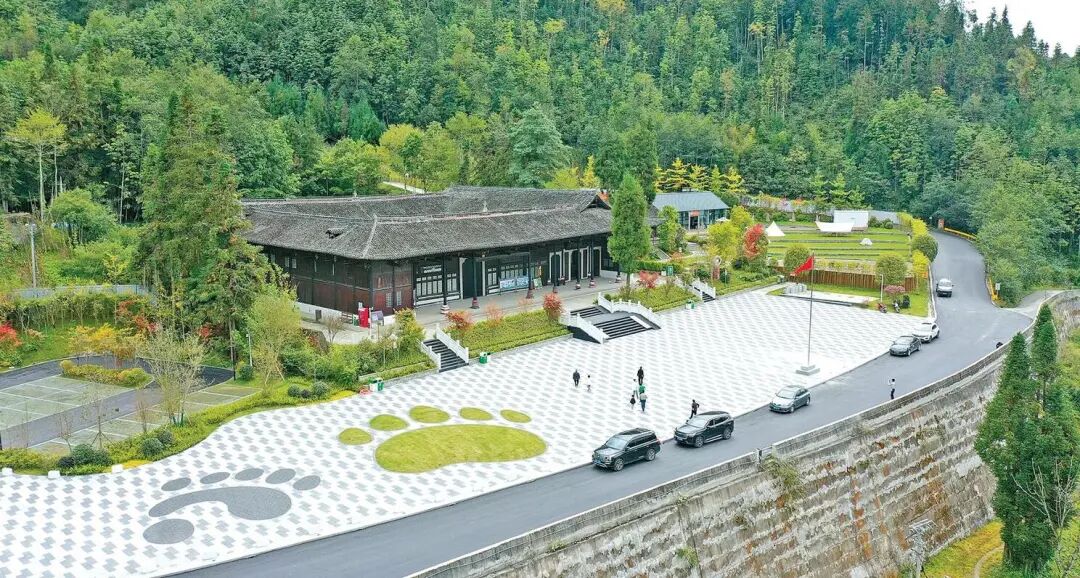
In 2026, the Giant Panda National Park marks its fifth anniversary. As the place where the giant panda was first scientifically discovered and one of the species’ key conservation areas, the Ya’an section of the national park has spent the past five years advancing ecological conservation, green development and community benefits.
Today, the region is creating a new picture of coexistence—where nature is given more space, wildlife thrives, and local communities benefit from a healthier environment.
Restoring Connected Habitats
A Better Home for Pandas and Other Wildlife
“Panda, panda!”
Early in the morning on June 7, villagers in Qiaoqi Tibetan Township, Baoxing County, were picking wild vegetables in the mountains when one of them looked up and spotted a wild giant panda walking through the forest.
It was drizzling lightly. She quietly called out to the panda, but it soon disappeared into the dense green forest.
It was her first-ever encounter with a wild giant panda.
Just two days later, on June 9, a forest ranger in Baoxing also came across a wild panda. The two encounters happened only two days apart.
In Ya’an, however, such encounters are no longer unusual.
Baoxing, where the first giant panda was scientifically discovered, is often known as the “hometown of giant pandas.”
The Ya’an section of the Giant Panda National Park covers 5,936 square kilometers, accounting for 27 percent of the park’s total area nationwide. Nearly 40 percent of Ya’an’s total land area has been included in the national park, covering three major mountain ranges: the Qionglai Mountains, Daxiangling Mountains and Xiaoxiangling Mountains.
Ya’an ranks first among Chinese cities in six areas related to giant panda conservation, including the area included in the national park, the proportion of the city covered by the park, the number of mountain ranges involved, the number of pandas sent abroad as national gifts, panda rewilding and release, and the completeness of its conservation system.
Since the founding of the People’s Republic of China, 24 giant pandas have been sent overseas as symbols of friendship, and 18 of them came from Ya’an.
The city is also one of the few places in the world that has witnessed the full story of giant panda conservation—from scientific discovery and breeding to rewilding and release.
With such a large panda population, wild pandas occasionally wandering close to villages has become increasingly common.
In 2025 alone, 260 signs of giant pandas were recorded in the Ya’an section of the park, while people encountered wild pandas 18 times. More than 3,200 signs of other wild animals were also documented.
In Shimian County, monitoring efforts have identified 33 individual giant pandas, including Tao Tao, Ba Xi and Hua Yan, three pandas that were previously released into the wild. They have successfully adapted to their natural environment and now live like other wild pandas.
But giant pandas are more than just China’s beloved national treasure. They also serve as an “umbrella species,” meaning that protecting their habitat also helps protect countless other forms of life.
At the integrated law enforcement center for the Giant Panda National Park in Tianquan County, a large smart monitoring screen displays real-time images from across the Labah River area.
Groups of sambar deer can be seen searching for food near forest streams, while other animals occasionally move through the distant mountains.
Through its smart management system, Tianquan has captured large amounts of footage of wildlife, including giant pandas, red pandas and Asian black bears. The system has also recorded rare images of black-necked cranes during migration.
By protecting giant panda habitats, Ya’an is also helping safeguard biodiversity across the region.
Baoxing, often described as a “gene bank of the world’s plants and animals,” is home to 1,837 plant species and 1,083 animal species. A total of 602 plant and animal species were first scientifically discovered and named there.
The population of the Chinese monal, a rare bird species, has also gradually recovered—from just 11 known individuals worldwide in 2017 to around 30 today.
In the Shimian section, a recent plant survey identified 1,165 species, including 646 species newly recorded in the area and three newly discovered nationally protected plant species.
Meanwhile, rangers in Yingjing captured the first local footage of the rare Sichuan partridge.
Over the past five years, Ya’an has restored 493.34 hectares of giant panda habitat. Three ecological corridors across Tuowu Mountain, Niba Mountain and Erlang Mountain are gradually being connected.
At the Niba Mountain corridor, 80 hectares of habitat have been restored, with 12,000 native trees planted.
The road home for giant pandas is becoming wider—and the home they share with thousands of other species is becoming more beautiful.
From Coal and Mining to Panda-Themed Homestays
Local Residents Find New Opportunities in a Greener Economy
On the morning of June 15, Hu Tailun opened the window of his homestay in Fazhan Village, Longcanggou Town, Yingjing County.
Outside, green mountains stretched into the distance, while birds sang in the trees.
Twenty years ago, he could hardly have imagined such a life.
During the 1980s and 1990s, Fazhan Village relied heavily on small coal mines and logging operations. As a result, the local environment gradually deteriorated.
“Back then, whenever trucks passed by, they kicked up coal waste mixed with dirty black water,” many villagers recalled.
Since the launch of the Giant Panda National Park pilot program, Ya’an has phased out 77 mining rights and closed 188 small hydropower stations.
A major ecological restoration project for abandoned mines, with a total investment of 500 million yuan, has restored more than 1,090 hectares of land and repaired 106 abandoned mining sites.
The restoration work in Shimian has also been selected as a national example of ecological restoration.
Hu once made his living by relying directly on the mountains. Today, he runs a homestay.
His business now has more than 20 rooms, with an occupancy rate of around 60 percent.
“Before, we could only earn enough to support our families,” he said. “After opening the homestay, our lives have improved. We now have cars and homes of our own. And it’s not just my family—the whole village has changed.”
Today, Fazhan Village has more than 60 panda-themed homestays, forming three major homestay clusters.
The transition was not always easy.
At one point, too many homestays and intense price competition created problems for local businesses.
To address this, the local government helped establish a Panda Homestay Alliance, encouraging businesses to share resources, follow common standards and avoid destructive price wars.
But how could the village attract visitors during the off-season?
The answer was found in the forests.
Yingjing has a forest coverage rate of 80.3 percent and is home to 81 nationally protected wildlife species and more than 400 bird species.
As the ecological environment improved after the establishment of the national park, wildlife sightings became more frequent, creating new opportunities for local tourism.
Because of his familiarity with the mountains, Hu became one of the first ecological guides in the area, leading visitors to watch birds and explore local plants.
His visitor numbers increased by 30 to 40 percent.
“The mountains are beautiful, the air is fresh, and I can earn a living while enjoying the work,” he said with a smile.
Birdwatching is now becoming a new attraction for Ya’an’s rural communities.
In May, a nature guide training camp was held in Longcanggou Town. All 25 places were quickly filled, with most participants coming from local homestays, farm restaurants and nearby villages.
More and more residents are now moving from simply relying on natural resources to protecting and benefiting from them.
Across Ya’an, the construction of national park gateway communities is also making progress.
Baoxing’s Muping Community has developed into a wildlife-friendly community, while Dengchigou Community is expanding cooperation in scientific and educational tourism.
In Tianquan, the main construction of the Labah River gateway community has been completed, with a total investment of 150 million yuan. A nature education center has also opened.
Yingjing has renovated its giant panda science center, while visitor facilities are being developed in Lushan’s Dachuan Community.
The science center at Menghuo City in Shimian has already welcomed around 5,000 visitors.
Gateway communities in Muping, Longcanggou and Labah River have been included among China’s 10 key national park gateway communities.
Ya’an was also one of the earliest places in China to begin building such communities and has the largest number among cities and prefectures.
Meanwhile, insurance coverage for wildlife-related damage now covers the entire Ya’an area.
A total of 554 compensation cases have been handled, providing additional protection for both local residents and wildlife.
Smart Conservation and “Panda Carbon”
Turning Green Mountains into a Green Economy
In Tianquan County, conservation is becoming increasingly high-tech.
At the integrated law enforcement center, staff can monitor vast areas of forest with just a few clicks.
The system combines satellite remote sensing, aerial photography and ground-based sensors to create an integrated monitoring network covering everything from dense forests to remote mountain areas.
“In the past, collecting data in the field mainly depended on rangers setting up infrared cameras,” said Zhou Feng, a staff member at the Tianquan management station of the Giant Panda National Park.
“Batteries had to be replaced, and memory cards had to be collected manually.”
Today, more than 1,100 infrared cameras have been installed across the Ya’an section of the park.
Rangers have completed patrols along 171 fixed routes, covering a total distance of more than 10,000 kilometers.
Drones are also being used to strengthen monitoring, creating a more comprehensive digital management system.
More than 530 rangers have taken part in forest fire prevention and response efforts, helping the Ya’an section of the national park maintain a record of zero forest fires.
In the future, AI technology will also be used to improve species identification, wildfire warnings and the detection of illegal activities.
But as the environment improves, another question remains: How can green mountains and clear waters create real benefits for local communities?
Different parts of Ya’an are exploring their own answers.
In Baoxing, logging restrictions apply to some collectively owned commercial forests within the core area of the national park.
To create new income opportunities for local residents, Baoxing launched a “Panda Carbon” project.
The project provides scientific management and regular care for forests where logging is restricted, helping improve their ability to absorb carbon dioxide.
The economic opportunity cost of conservation is then turned into income through carbon credits.
The project currently covers 12,200 mu, or around 813 hectares, benefiting 395 farming households. Its total expected income is estimated to exceed 6 million yuan.
“In Baoxing, you can even make money from clean air,” said Wang Shuangquan, director of the Baoxing Forestry Bureau and deputy head of the Baoxing management station of the Giant Panda National Park.
In Dengchigou, Baoxing, the Giant Panda Origins Camp is located deep in the forest and is known as “a nature classroom without walls.”
Children can take part in hands-on activities, including traditional papermaking using processed giant panda droppings and making food for giant pandas.
One of the most popular activities is making “panda paper.”
After being washed, processed, cooked and dried, plant fibers are extracted from panda droppings and turned into paper with a unique natural texture.
“Instead of simply telling people about conservation, we let them experience it with their own hands,” said Chen Yang, a staff member at the camp.
“So ecological protection becomes something people can see, touch and remember.”
Since the beginning of this year, the camp has provided educational programs for more than 2,000 participants. It has also welcomed groups from Mexico, the United States, Spain, Finland and other countries and regions.
On June 2, the “Beautiful China Journey: Exploring National Parks” media tour was launched in Dengchigou, Baoxing.
Journalists from more than 10 national media organizations and dozens of other media outlets began their journey in Baoxing before visiting areas of the Giant Panda National Park across Sichuan, Shaanxi and Gansu provinces.
Their stories highlighted the beauty of China’s national parks and the growing harmony between people and nature.
At the same time, Ya’an is continuing to strengthen international communication about its ecological conservation efforts.
Working with media organizations at different levels, the city has produced the ecological tourism video Let’s Go to Ya’an to See Pandas, along with six naked-eye 3D promotional videos. An international communication base for the Giant Panda National Park has also been established in Ya’an.
The story of the giant panda is now reaching audiences around the world.
Five years may be only the beginning for a national park.
But in Ya’an, these five years have already brought remarkable change—from giving more space back to wildlife to helping people and pandas share the mountains; from coal-stained hillsides to green mountains and clear waters.
The Ya’an section of the Giant Panda National Park is showing how ecological conservation, green development and better livelihoods can move forward together.
And the story of this remarkable home is still being written.