Ya'an: Under the Umbrella Effect, Life Thrives
Editor's Note: August 15, 2026, marked the third National Ecology Day since its establishment. As an important part of Giant Panda National Park, Ya'an is blessed with exceptional ecological resources. For years, the city has placed giant panda conservation at the heart of its ecological protection efforts, extending the benefits of the panda's "umbrella effect" to forests, vegetation and countless other wildlife species. Through long-term, systematic conservation, Ya’an continues to write a story of coexistence between people and nature.
The beauty of an ecosystem lies in persistent, meticulous care. Its true value lies in a relationship where people and nature thrive together.
This series looks at Ya'an’s living examples of ecological conservation and the people working quietly on the front lines. It tells the stories of a keeper who has spent decades breeding the endangered Chinese monal, helping grow its captive population from fewer than 10 birds to 33 and achieving a fourth-generation breeding breakthrough; a ranger who spends his days deep in the mountains documenting wildlife, recording species such as the yellow-rumped honeyguide for the first time in Sichuan; and an urban bird conservationist who spent eight years transforming a small river island into a thriving bird sanctuary, where nearly 600 nests are now fully occupied and 412 bird species have been recorded.
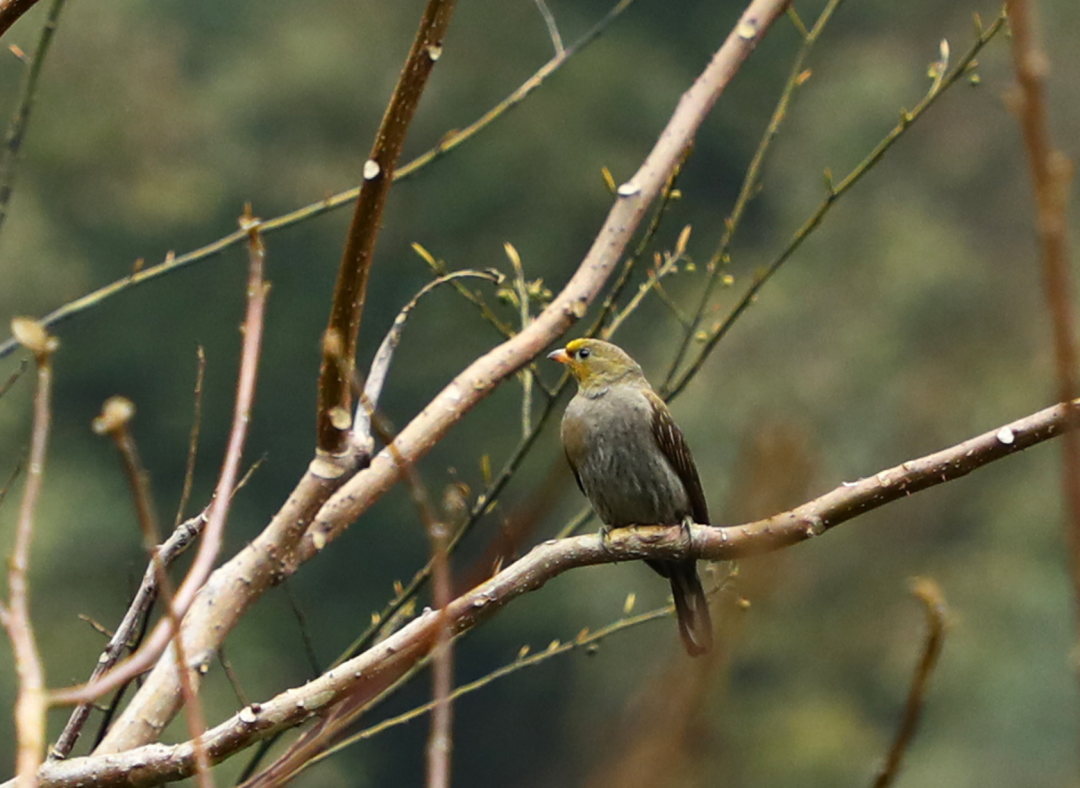
Yellow-rumped Honeyguide
Photo by Song Xinqiang
From rare species conservation and wildlife monitoring in the mountains to shared efforts to build greener cities, Ya’an is extending the protection once centered on the giant panda across an entire landscape.
These moments of coexistence between people and wildlife offer a glimpse of Ya’an’s long-term commitment to biodiversity conservation. They also reflect a simple ecological truth: when the protection surrounding an umbrella species reaches far enough, countless other forms of life find a place to call home.
01 Bringing New Life Into the World
For conservationists, breeding the next generation is one of the most important jobs of all.
At 8:30 on the morning of August 12, sunlight began to filter through the mountains and into the management center of Sichuan Fengtongzhai National Nature Reserve.
Keeper Ma Hong entered an enclosure carrying a tray of food. He set it down, stepped back a few paces and crouched quietly to watch.
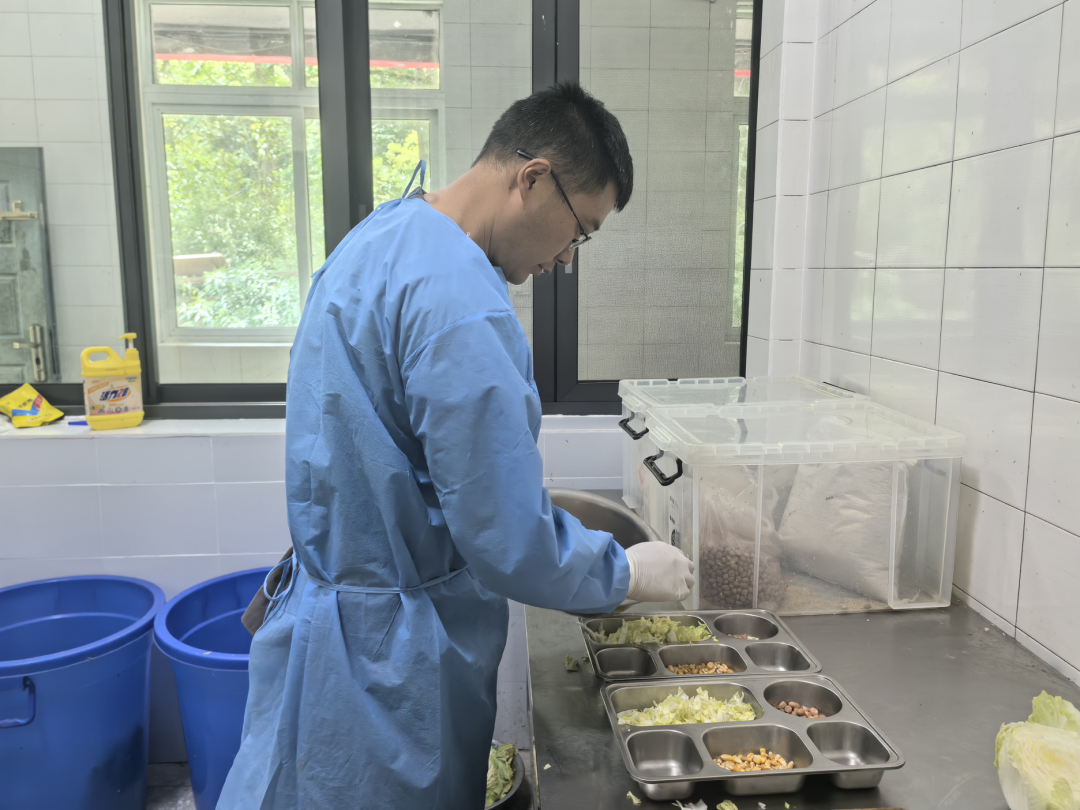
Preparing meals for Chinese monals is part of Ma Hong’s daily routine.
Photo by Lu Nina
A Chinese monal emerged from the shade and slowly approached the tray. It pecked at a few leaves, then paused and looked up at him. After making sure there was no danger, it continued eating.
Ma Hong simply watched.
For 20 years, he has fed the birds twice a day.
Once they finish eating, they leave immediately. They never linger.
When sunlight falls across the bird’s feathers, shades of copper red, metallic green and blue-violet shimmer at once. More than a dozen colors seem to come alive.
“I had never seen such a beautiful bird in the mountains before,” Ma recalled.
He first saw one as a student while passing through the reserve. From a distance, he spotted the bird and later excitedly told his parents about it. They told him its name, and he never forgot it.
In 2000, Ma became a keeper at Sichuan Fengtongzhai National Nature Reserve.
His first job was caring for giant pandas.
“I’ve loved animals since I was young. There are monkeys, black bears and Lady Amherst’s pheasants in these mountains,” he said, smiling like a child. “What made me proudest was being able to care for giant pandas. After all, they’re China’s national treasure.”
Then, in 2006, the pandas were transferred elsewhere.
“There was no Giant Panda National Park at the time,” Ma said. “The pandas I had raised left, and I cried several times. I really didn’t want to say goodbye.”
But the work of conservation continued.
One day, he was asked whether he would be willing to take on a new challenge: breeding Chinese monals.
It was the bird he had remembered since childhood.
He agreed immediately.
But caring for birds was very different from caring for pandas.
“Pandas become familiar with people. Birds don’t,” Ma said. “You bring in the food, they come over and eat. Once they’re full, they turn around and leave. You can call them, but they won’t come back.”
“At first, it felt strangely empty.”
The first decade was filled with curiosity and excitement. Every day, seeing those rainbow-like feathers made the work feel worthwhile.
But after 10 years, the feeling began to change.
“There were times when it became repetitive and tiring,” he said.
The same schedule.
The same food tray.
The same bird disappearing into the enclosure.
Yet he stayed.
Because one challenge after another stood in front of him.
Li Wanhong, head of the Science Education and Publicity Section at the reserve’s management center, explained that captive breeding of Chinese monals faces three major challenges: fertilization, incubation and survival.
“Males need around three years to reach sexual maturity. Females usually lay only three or four eggs at a time, and even fewer hatch successfully.”
What troubled Ma most were the chicks.
“Sometimes we finally managed to hatch one, only for it to die during transfer,” he said.
Some had physical disabilities. Some failed to develop properly. Others died from disease.
“One after another, they were gone. And there was nothing I could do.”
Research into captive breeding of Chinese monals began at the reserve as early as 1992, but progress remained slow for decades.
By 2017, only 11 Chinese monals were known to be surviving in captivity nationwide.
Ma Hong, left, and a colleague observe the incubation of Chinese monal eggs.
Photo provided by the interviewee
Still, every morning at 8:30, Ma carried his food tray into the enclosure.
And every afternoon at 4, he returned.
That routine has remained unchanged for 20 years.
A turning point came in 2017, when China’s first Chinese Monal Conservation and Research Center was established at Fengtongzhai.
In 2022, the center began working with a research team from China West Normal University.
A year later, the team successfully hatched chicks through artificial insemination for the first time.
“That was a decisive breakthrough,” said Zhang Long, an associate researcher at the university’s Institute of Ecology.
“Before that, we had worked for years without seeing real results. At times, we even thought about giving up.”
Then came the spring of 2024.
Three pairs of Chinese monals laid 13 eggs. Eleven were fertilized, and nine chicks successfully hatched.
The fertilization rate reached 85 percent, while the hatching rate reached 82 percent.
For the first time, fourth-generation offspring were successfully produced, with several key indicators reaching record highs.
Ma was there.
“I was excited every time a chick hatched,” he said. “I don’t care which generation it is. As long as a new bird comes out of the egg, I’m happy.”
Today, the Chinese monal population at Sichuan Fengtongzhai National Nature Reserve has grown from fewer than 10 birds to 33.
And the story is not limited to the breeding enclosures.
The establishment of Giant Panda National Park has brought stronger protection to the entire mountain ecosystem.
The mountains where Chinese monals live are also home to giant pandas.
Ma knows, however, that the work is far from over.
Artificial insemination remains unpredictable. Disease can strike at any time.
“That’s probably why I’m still here after 20 years,” he said.
The long-term goal is even more ambitious.
“Eventually, we hope to build the captive population to 100 birds and, ultimately, achieve reintroduction into the wild, just as has been done with giant pandas,” Zhang said.
Ma is now 43 and has two children, aged 12 and 6.
“I probably spend more time with the birds than with my own children,” he said.
His colleagues call him “Bird Dad.”
He doesn’t make grand speeches. He simply keeps working.
For 20 years, he has carried that tray of food into the enclosure every day.
And when sunlight catches the feathers of a Chinese monal, revealing the same dazzling colors he first saw decades ago, he still thinks they are beautiful.
Behind the enclosure rises the mountain.
Chinese monals live there.
So do giant pandas, golden snub-nosed monkeys and takin.
They share the same forest and drink from the same streams.
“There are so many animals in these mountains,” Ma said. “If the mountains are healthy, they’re all doing well.”
He picked up his tray and walked into the next enclosure.
The following morning, at 8:30, he would be back again.
02 Sharing the Treasures of the Mountains
Song Xinqiang owns two 4-terabyte hard drives filled with photographs taken in the mountains.
Birds.
Mammals.
Frogs.
Insects.
Plants.
He often shares these treasures on social media.
“There’s only one thing missing,” he said. “I still haven’t photographed a wild giant panda.”
Song is head of the Scientific Research and Monitoring Unit at the management center of Daxiangling Nature Reserve in Yingjing County.
His job often involves collecting panda droppings, monitoring populations and tracking wildlife deep in the mountains.
He is, in a sense, someone who spends his days “chasing” wild giant pandas.
Among his photographs is one of his favorites.
A bird is flying beneath a giant panda sculpture holding an umbrella.
“That,” he joked, “is the real umbrella effect.”
“Protecting giant pandas means protecting the entire habitat,” he said. “When the habitat improves, all the species living alongside them benefit too.”

Song Xinqiang photographs wildlife in the field.
Photo provided by the interviewee
In 2017, the pilot program for the Giant Panda National Park system was launched.
That same year, Song, who had just completed his master’s degree at the Kunming Institute of Zoology under the Chinese Academy of Sciences, came to Ya’an to work as a field monitoring ranger.
He had already developed the habit of carrying a camera while studying zoology.
“When you study animals, you need to photograph species and habitats. You need records,” he said.
After beginning his fieldwork career, the camera became something he rarely left behind.
There was one exception.
During a field survey, he unexpectedly encountered a Sichuan takin only about three meters away.
But that day, he had not brought his camera.
Used to documenting wildlife with professional equipment, he did not immediately think of the phone in his pocket.
By the time he remembered, the animal was gone.
He never got a photograph.
Since then, Song has preferred carrying several extra kilograms of equipment to entering the mountains empty-handed.
In January 2020, during a transect survey, he photographed an ordinary-looking bird.
At the time, he assumed it was a common species.
Two years later, while compiling a wildlife photo collection, an expert noticed the image.
“This is a yellow-rumped honeyguide,” the expert told him. “It’s a new bird distribution record for Sichuan.”
The species is primarily found in Pakistan, northern and northeastern parts of the Indian subcontinent and northeastern Myanmar. Within China, it had previously been recorded in the Gaoligong Mountains of Yunnan and in Tibet.
The bird Song photographed represented the northernmost known record of its distribution at the time.
“If I hadn’t been working on that photo collection, I might still not know what I had photographed,” he said.
The yellow-rumped honeyguide was not his only important discovery.
Song also photographed the first field records of species including the Temminck’s tragopan and the golden-spined toad from Ya’an.
These observations helped fill gaps in known species distributions and provided valuable baseline data for future research and conservation.
The Yingjing section of Giant Panda National Park is also an important stopover area along the migration route of black-necked cranes.
Every spring and autumn, groups of cranes pass through and rest there.
This spring, one of Song’s colleagues filmed them and posted the footage on Douyin, drawing widespread attention.
“Posting on Douyin is also a form of science communication,” Song said.
But there was something else that mattered even more to him.
“The fact that the cranes are willing to stop here means they feel safe.”
In recent years, as giant panda habitat restoration has continued, the umbrella effect of panda conservation has become increasingly visible.
Wildlife diversity is growing, and animal activity has become more frequent.
“Take birds as an example,” Song said. “Earlier scientific surveys recorded more than 260 bird species in Daxiangling Nature Reserve. Now, the number is over 400.”
The change did not happen overnight.
“It has happened gradually, year after year.”
The distance between birds and people has also changed.
“When we photograph birds, we can clearly feel that their flight distance has become shorter,” he said. “It used to be dozens of meters. Now it can be just over ten meters, sometimes even closer.”
The transformation is not limited to the mountains.
In Longcanggou Township, Yingjing County, local resident Hu Tailun once made his living directly from the mountains.
Today, he is a well-known local birding guide who takes visitors into the forests to observe wildlife.
His social media posts are filled with recent sightings and updates from the field.
“For me, taking people to see these birds is a way of introducing these treasures to the outside world,” Hu said.
Villages at the foot of the mountains are changing as well.
In the past, some residents entered the forest to collect medicinal plants or hunt wildlife.
Today, with greater environmental awareness, people are more likely to contact conservation workers when they find injured animals.
They also remind their families:
“You can’t hunt that.”
“You can’t dig that up.”
This May, Song hosted a livestream on Bilibili, sharing stories from the mountains with nearly 5,000 viewers.
He explained how panda droppings can be used to monitor populations and how infrared cameras work.
Some viewers asked how they could join fieldwork.
Others said it was the first time they had understood what giant panda conservation actually involves.
Over the past nine years, Song has led seven scientific monitoring projects and contributed to more than 10 academic papers.
One study published in Restoration Ecology found that habitat restoration measures in giant panda habitats such as Daxiangling had created better conditions for understory plants, while the average annual number of wildlife species in the area had increased compared with baseline levels by 2025.
But Song still has one wish left unfulfilled.
Last winter, he used a drone to search for monkey troops in Baoxing County.
Unexpectedly, a giant panda appeared in the frame.
He and his colleagues immediately set off after it.
The forest was dense. There were no paths.
They moved forward.
So did the panda.
The black-and-white figure never appeared in his camera lens.
It was the closest Song had come to seeing a wild giant panda in his nine years of work.
“I still haven’t seen one with my own eyes, and that’s a little disappointing,” he said.
“But it also keeps me motivated.”
“The fact that I still haven’t photographed one makes me want to go into the mountains even more.”
“There are so many treasures out there. Every extra trip means there’s a chance to discover—and share—another one.”
03 Giving Birds a Home in the Heart of the City
It was not yet 6 a.m. on August 13.
The city was still asleep.
But on a 600-square-meter bird island along the Qingyi River, the dawn chorus had already begun.
Known as the “Half-Meter Home,” the island has become a sanctuary for birds in the middle of Ya’an.
Luo Xiangbing, president of the Ya’an Bird Protection and Birdwatching Association, got up from his small cabin and began scrolling through local short videos.
He was looking for posts from residents asking for help with injured birds.
People call him “Uncle Bird.”
When it comes to birds in Ya’an, there is little he doesn’t know.
It was another ordinary morning in the eighth year since the bird island was established.
And the beginning of another 24-hour watch.
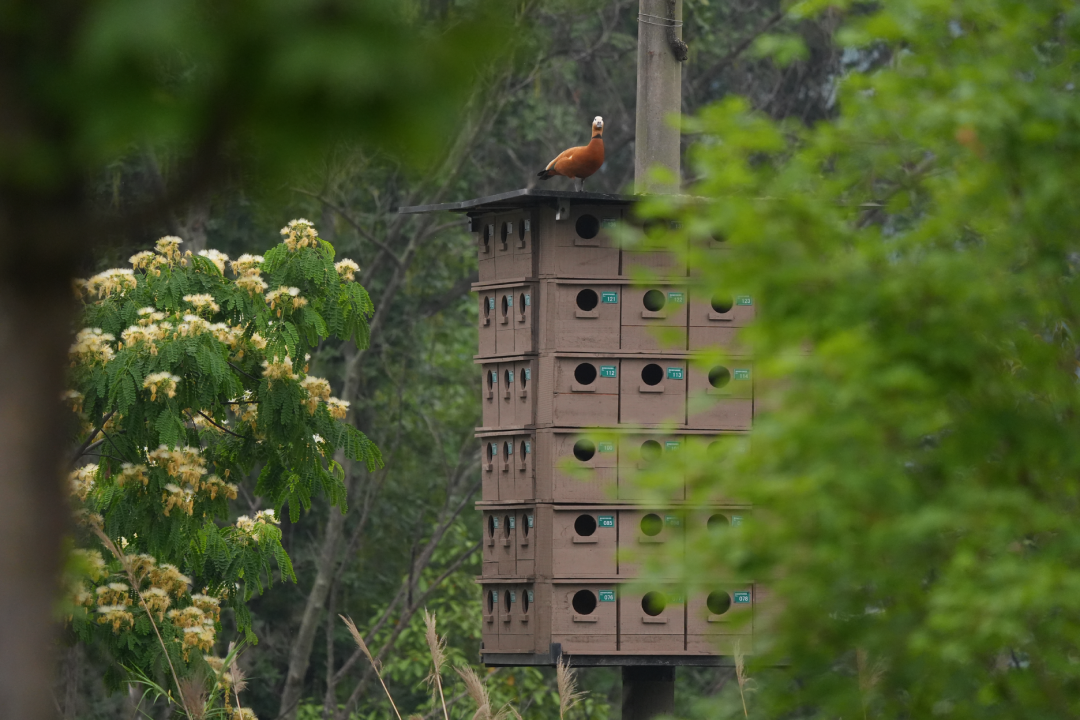
Birds thrive among the nesting facilities on the island.
Photo by Wan Chunyan
As daylight slowly appeared, Luo stepped outside with his binoculars and quietly observed the birds around the island.
By around eight or nine in the morning, he entered the rehabilitation area to change dressings, bandage injured birds and prepare food.
In July and August alone, Luo and his team rescued nearly 80 wild birds.
More than 30 of them were nationally protected species, including crested goshawks, northern boobooks and collared scops owls.
The team also rescued more than 40 mandarin duck chicks.
At 10 a.m., Luo packed his binoculars and tools and set off on an electric scooter to patrol the river.
His route covers more than a dozen kilometers across Ya’an’s urban area.
From Ximen Bridge in the old city, he follows the Qingyi River eastward, passing Daxing Taohuadao Park and continuing toward Shuijinguan.
Riverbanks, mudflats, wooded areas and shallow wetlands are among his main patrol zones.
He knows the city’s bird gathering spots well.
Whenever he finds an injured bird, he brings it back to the island.
Around noon, Luo returns.
Lunch is often delivered by his wife, Guo Yuping.
When she talks about her husband’s devotion to bird conservation, she sometimes sounds amused—and occasionally a little exasperated.
But behind the complaints is years of quiet support, as she has taken on much of the family’s daily responsibilities.
After a short break, Luo sorts rescued birds, keeps different cases separated and provides treatment according to their conditions.
Once they recover, most are released back where they were found.
He knows that many wild birds have relatively fixed territories and generally remain within about one kilometer of their nests.
At 5 p.m., Luo returns to the enclosures.
A crested goshawk had recently suffered a head injury after colliding with a high-rise building.
Luo cuts fresh beef into small pieces and feeds the bird while monitoring its recovery.
Routine feeding takes place twice a day.
For newly rescued birds, however, he often sets alarms and checks on them every two or three hours.
As night falls, infrared cameras begin recording the movements of rare birds after dark.
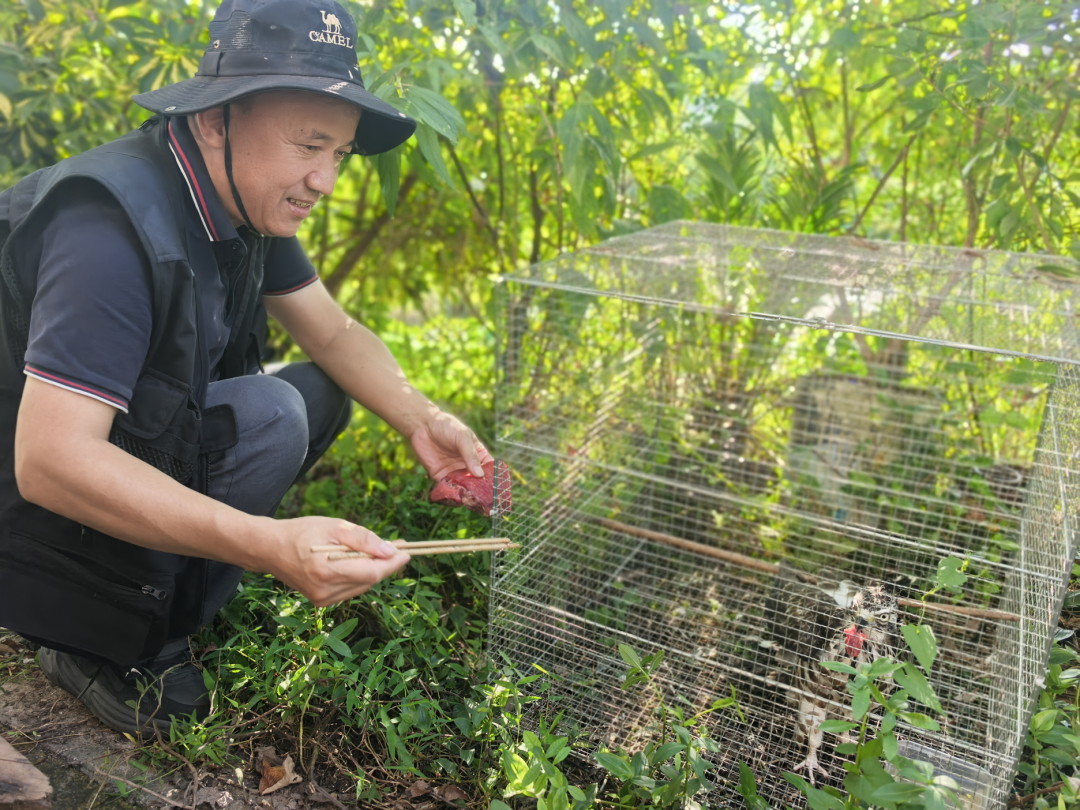
Luo Xiangbing feeds fresh beef to a crested goshawk recovering from a head injury caused by a collision with a building.
Photo by Gao Feifei
Since the “Half-Meter Home” was established in 2018, Luo has volunteered to remain on duty during holidays—even on Lunar New Year’s Eve—so that other bird protection volunteers can return home to their families.
Bird conservation has become inseparable from his life.
But Luo’s connection with birds began long before the island.
A skilled artist in his younger years, he spent a decade creating illustrations for the Chinese magazine Reader.
His love of birds eventually led him to focus on wildlife illustration.
Since 2013, he has devoted himself to urban bird conservation and has participated in compiling publications including Birdwatching in Ya’an, while also serving as chief editor of Rare Birds in Ya’an.
At the time, the Gaijiaba river shoals were far from a safe haven.
Bird traps and fishing nets could often be found there.
For birds, finding a peaceful place to live was not easy.
Then came a turning point in 2018.
The site, located in the heart of the city, had originally been planned for commercial development.
But Ya’an made a different choice.
Rather than competing with birds for land, the city halted the commercial project, designated the area for ecological protection and established the “Half-Meter Home” bird island observation station.
But creating a sanctuary was only the beginning.
The next challenge was persuading birds to make it home—and to keep returning.
At the end of 2018, Luo’s team hung 20 artificial nests.
To their surprise, mandarin ducks moved in on the very same day.
The first success gave everyone hope.
In 2019, the team added another 102 individual nests.
Less than half an hour after they were installed, every one had been occupied.
Bird lover Dai Yaping still remembers the moment.
“Housing was in such short supply,” she said. “There were still so many birds without nests. They really needed safe places to live.”
There were only so many trees on the island where nests could be hung.
So how could they create homes for even more birds?
In 2020, Luo and his team began experimenting with ways to combine multiple nests into a single structure.
The first generation of their “urban rare bird communal breeding nest” was born.
In the spring of 2021, the association worked with the Sichuan Academy of Forestry to improve the design.
The result was a new type of communal breeding structure capable of housing between 36 and 72 nesting pairs in each unit.
The innovation allows multiple urban bird species to breed within the same structure.
In 2025, the design received a national invention patent, filling a gap in this area of research and practice.
Today, the 600-square-meter river island is surrounded by around 6,000 square meters of artificial mudflats where young birds can forage.
Together, the area has developed a rare model of concentrated, multi-species urban bird breeding.
Birds settle into different layers of the habitat according to their natural habits.
Peregrine falcons, common kestrels and magpies occupy the highest parts of the trees.
Owls and scops owls nest in individual boxes among the woodland.
Social mandarin ducks move into communal, grid-like nesting structures.
Greater coucals and thrushes prefer dense vegetation.
Little ringed plovers choose sandy riverbanks.
Common moorhens, cotton pygmy geese and white-breasted waterhens build nests on floating ecological platforms.
Kingfishers, meanwhile, favor what Luo jokingly calls “river-view apartments” in the stone embankments.
So far, 54 bird species have been recorded breeding steadily on the island.
Each year, between 300 and 500 rare bird chicks hatch there.
Mandarin ducks and several owl species have established stable second- and even third-generation urban populations.
By around the beginning of spring each year, nearly 600 nesting spaces are essentially fully occupied.
The gathering of birds has become a distinctive ecological scene along the Qingyi River.
The model developed on Ya’an’s bird island is now attracting attention beyond the city.
This March, a group of experts, including renowned ornithologist He Fenqi of the Chinese Academy of Sciences and Qian Fawen from the National Bird Banding Center, visited the site for a field study.
They highly praised Ya’an’s efforts, noting that there had previously been no mature model for concentrated bird settlement and large-scale population recovery in an urban environment.
Ya’an, they said, had become the first city to systematically complete such a concentrated breeding conservation practice.
In 2026, visitors from Chengdu, Jinan and Hong Kong have come to study the project and explore whether Ya’an’s communal breeding model could offer new approaches to bird conservation in urban parks.
As dusk slowly settles over the Qingyi River, Luo stands on the observation platform and looks toward the nesting structures scattered across the island.
Eight years ago, this was little more than an ordinary stretch of riverbank.
Eight years later, it has become alive with birds.
So far, 412 bird species have been recorded on the island—nearly 70 percent of the 605 bird species documented in Ya’an.
They include eight species under China’s first-class national protection and 68 under second-class national protection.